Tuesday, March 18, 2014
WPP #13-14: Unit P Concepts 6-7: Law of Sines and Law of Cosines
This blockbuster of a blog post was a co-op with the ingenuous swag of Omar T. To view the actual blog post along with some more swaggy content, please do not hesitate to click here.

Saturday, March 15, 2014
BQ #1: Unit P Concepts 1-3 and 4-5: Law of Sines (Derivation) and Area Formulas (Oblique Derivation)
1). Deriving the Law Of Sines:
The Law of Sines is used to solve non-right triangles, specifically ones in which we already know or are given two angles and a side either after the two angles or between the two angles (non-right triangles with AAS or ASA relationships). This is useful because most triangles are not right triangles. The Law of Sines is as depicted below:
 |
| http://www.mathwarehouse.com/trigonometry/law-of-sines/formula-and-practice-problems.php |
 |
| http://www.regentsprep.org/Regents/math/algtrig/ATT12/derivelawofsines.htm |
- We first draw a non-right triangle and label the sides and angles respectively. We then draw a height (h) perpendicular down from angle B, making two right triangles.

- Now, using basic trig functions, we could see that sinA = h/c and sinC = h/a. If we solve for "h" in both equations we get csinA = h and asinC = h. Since both csinA and asinC are now equal to h, they are also both equal to each other (Transitive Property).

- Set csinA and asinC equal to each other. Divide by ac on both sides and we get the Law of Sines (sinA/a = sinC/c). Say we used angle B instead of angle C, we should get sinA/a = sinB/b , and since they are all equal to each other, the order can be switched around to make the whole Law of Sines: sinA/a = sinB/b = sinC/c.
4). Area Formulas: Deriving the Area of an Oblique Triangle formula
The formula for the area of a triangle is A = 1/2bh and this works fine with right triangles since h is just one of the sides. But with an oblique triangle, h, which is the height of the triangle, is a little more complicated. Thus there is a distinct way to find the area of an oblique triangle, in which the value of h is unknown. The following steps walks through how we come up with this distinction in the area formula:
- First draw your oblique triangle and label the sides and angles. Draw the height of the triangle (h). We know that the area of the triangle is 1/2 times the product of the base and the height, but what's h?

- Similar to what we did for the law of sines, if we take the sine of angle C we see that sinC = h/a. We can then solve for h and we get h = asinC. We now have a value for h, which we can plug back into the area formula.
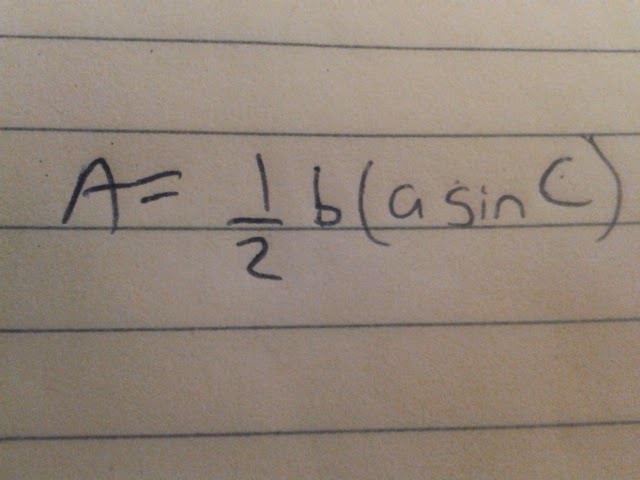
- We have taken our value for h and plugged it back into the area formula. All you need to fund the area using this formula is two sides and the sine of the angle between them (SAS), in this case our two sides would be side b and side a, and angle C would be between them. We can see that this is essentially the same formula as the original area formula for a triangle; the only difference is we have to find and use a certain substitute value for h because the height is not always given in an oblique triangle.
References:
First Picture: The Law of Sines: http://www.mathwarehouse.com/trigonometry/law-of-sines/formula-and-practice-problems.phpSecond Picture: Deriving Law of Sines: http://www.regentsprep.org/Regents/math/algtrig/ATT12/derivelawofsines.htm
Wednesday, March 5, 2014
WPP #12: Unit O Concept 10: Elevation and Depression Word Problems
 |
| http://art-sci.blogspot.com/2012/02/statue-of-liberty-gone-wild.html |
a). Sir Liftsalot just moved to Newark and is staring intently at the beautiful Lady Liberty from a distance of 19 feet. He looks up at a 71 degree angle in order to see the very top of that attractive statue. How tall is the statue? (not to scale)
b). Sir Liftsalot gets an awesome idea to take selfies from the top of the statue's head so that's exactly what he does. As he sends the selfies, he looks down from the statue at a friend who is 54 feet away from the statue on the ground. What's the angle of depression from Sir Liftalot's eye to his friend? (Assume that Sir Liftsalot's eye is 5 feet above the top of the statue and also be sure to get the height of the statue from the answer for part a).
Answers:
Part a).


Part b).


Tuesday, March 4, 2014
I/D# 2: Unit O Concepts 7-8: How can we derive our patterns for our speical right triangles?
Inquiry Activity Summary:
In class we were given a square with side lengths of 1 and an equilateral triangle, also with side lengths of 1. We were given directions to derive the patterns for the 45-45-90 and 30-60-90 triangles from the square and the equilateral triangle using only what we knew of the two shapes (ignoring any pre-knowledge of the 45-45-90 and 30-60-90 patterns). The following is how I accomplished this heroic task:1). Deriving the 30-60-90 pattern with an equilateral triangle:
First things first, you want to draw an equilateral triangle. We know the sides are all equal to 1 and we know that the three angles are all equal to 60 degrees in this equilateral.


2). Deriving the 45-45-90 pattern from a square
Okay. First I drew the square. Its sides will be one and like all squares this one will have 4 right angles.

Now we use the Pythagorean theorem to find that missing side. Again this is demonstrated below. We shall find that the missing side (this time "r") is equal to radical 2.


Inquiry Activity Reflection:
1). Something I never noticed before about special right triangles is... that they come from a square and an equilateral triangle, and that the patterns they follow are not just numbers that happen to work every time, but they actually came from what we did in this activity.2). Being able to derive these patterns myself aids in my learning because... learning something isn't just memorizing something with no meaning; this helps me understand what special right triangles really are.
Saturday, February 22, 2014
I/D#1: Unit N Concept 7: The Unit Circle- How do Special Right Triangles and the Unit Circle relate?
What are special right triangles?
- When talking about special right triangles in this class, we are referring to right triangles with specific angles
- These are triangles with 30-60-90 and 45-45-90 degree relations and as demonstrated above, the degrees will correlate with the side measures of the triangle with the specified formulas (note that the 30 and 60 degrees can switch spots in the 30-60-90; the side values will switch with the degree value). This is the rule of right triangles.
 |
| http://gmatprepster.com/wp-content/uploads/2012/07/GMAT-Right-Triangles-1.png |
INQUIRY ACTIVITY SUMMARY
Basically what we did in the activity was use each special triangle and set their hypotenuses equal to 1 since the radius of a unit circle is 1. We did this by using the rules of special triangles and simplified. In the end we get the values for x and y and used those to find the ordered pairs that relate to the unit circle. The following walks through the steps for each individual special right triangle.1). 30 Degrees Triangle:

- I first drew the triangle with the rules of special right triangles.

- I then simplified the three sides so that the hypotenuse was equal to one. In this case I divided everything by 2. We do this because the hypotenuse is really a radius in the unit circle and the radius of a unit circle is always 1.

- Next I labeled the hypotenuse 'r', the horizontal value 'x', and the vertical value 'y'. I also made note of their values.

- I drew a coordinate plane so that the triangle was in the first quadrant and the 30 degree angle was at the origin. I then found the ordered pair of each vertex of the triangle using the horizontal and vertical values (x and y).
 Write out with rules of right triangles
 Simplify to make hypotenuse equal to one
 Label r, x, and y. Note values


Lastly, I put the triangle in the first quadrant with the degree at the origin. I then found the ordered pair of the vertices using the values of x and y.
60 Degree Triangle: This triangle in particular is very similar to the first triangle. The only difference with the 30 degree triangle is that x and y will be switched. The following shows how I did the activity with this triangle:


- Note how this triangle has the same results as the 30 degree triangle except the x and y values are switched. This is because a 30-60-90 and a 60-30-90 triangle are basically the same triangle just switched the other way.
How Does This help us derive the unit circle?
Well for starters, all three of the triangles help make up the unit circle; they are repeated in each quadrant in different directions. Also, the coordinates of the top vertices of each triangle are all points on the unit circle. These points will be repeated throughout the circle just as the triangles are repeated. So essentially, these triangles are what makes the unit circle what it is, since a circle is the set of all points equidistant to a point known as the center and, in a unit circle, the points are derived from these three triangles.Quadrant Relevancy
The triangles we did in this activity were in the first quadrant. What happens to these triangles when we put them into quadrants II, III, and IV? The pictures below show the triangles in different quadrants:


INQUIRY ACTIVITY REFLECTION
1).Something I never noticed before about special right triangles is that they are used to derive the unit circle.2).Being able to derive these patterns myself aids in my learning because I now have a foundation to the unit circle and I actually understand where it comes from so I'm not just memorizing something that I don't really know what it is.
Monday, February 10, 2014
RWA #1: Unit M Concept 5: Ellipses
1). An ellipse is the set of all points such that the sum of the distance from two points known as the foci is a constant. (http://www.lessonpaths.com/learn/i/unit-m-conic-section-applets/ellipse-drawn-from-definition-geogebra-dynamic-worksheet)
2). Representing an Ellipse Graphically: An ellipse consists of a central point known as the center, 2 vertices connected with the major axis, and 2 co-vertices connected with the minor axis. The distance from the vertex to the center is known as 'a' and the distance from the co-vertex to the center is known as 'b'.
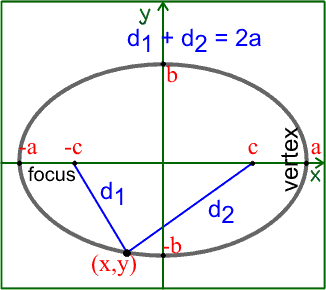
Ellipses also have 2 points known as the foci. As demonstrated in the picture to the left, The sum of the distance from these two points (d1 + d2) is always a constant (2a). This is essentially what makes an ellipse. Also, the distance from the focus to the center is known as c..
Algebraically: As the picture suggests, there are two different ellipses with their corresponding equations which differ slightly with the placement of 'a' and 'b'. If 'a' (the bigger value) is under the y term, then the ellipse will be a vertical/ skinny ellipse and if it is under the x term, then the ellipse will be horizontal/ fat. 'H' and 'k' represent the x and y coordinates of the center.
Important: It is significant to know the eccentricity regarding an ellipse. Eccentricity is how round a conic is, 0 being perfectly round. An ellipse's eccentricity is greater than 0 but less than 1. This could be written as e = 0 < x < 1. This is because an ellipse isn't perfectly round like a circle (whose eccentricity is 0) and yet it is more round than a parabola (whose eccentricity is 1). Eccentricity could be found by dividing 'c' by 'a' (c/a).
3). Real World Application: Elliptical Training Machinery
Elliptical gym equipment, such as elliptical runners/climbers are very useful when trying to avoid joint injury in a workout. Basically, the elliptical motion which is usually amplified with the use of handle bars or a motor drive, limits the impact on the joints that is very common with running. This article outlines this use for ellipses as well as a few other uses: http://www.ehow.com/info_8522010_real-life-uses-ellipses.html
...And this is a guy with a cool accent who will transmit elliptical knowledge to your brain in a brief 2 minutes:
4). URLs cited : Pictures from the top-down:
http://www.mathwarehouse.com/ellipse/equation-of-ellipse.php
| http://www.mathwarehouse.com/ellipse/equation-of-ellipse.php |
 |
| https://people.richland.edu/james/lecture/m116/conics/conics.html |
Ellipses also have 2 points known as the foci. As demonstrated in the picture to the left, The sum of the distance from these two points (d1 + d2) is always a constant (2a). This is essentially what makes an ellipse. Also, the distance from the focus to the center is known as c..
 |
| http://coachjpocconics.weebly.com/ellipses.html |
Important: It is significant to know the eccentricity regarding an ellipse. Eccentricity is how round a conic is, 0 being perfectly round. An ellipse's eccentricity is greater than 0 but less than 1. This could be written as e = 0 < x < 1. This is because an ellipse isn't perfectly round like a circle (whose eccentricity is 0) and yet it is more round than a parabola (whose eccentricity is 1). Eccentricity could be found by dividing 'c' by 'a' (c/a).
3). Real World Application: Elliptical Training Machinery
Elliptical gym equipment, such as elliptical runners/climbers are very useful when trying to avoid joint injury in a workout. Basically, the elliptical motion which is usually amplified with the use of handle bars or a motor drive, limits the impact on the joints that is very common with running. This article outlines this use for ellipses as well as a few other uses: http://www.ehow.com/info_8522010_real-life-uses-ellipses.html
...And this is a guy with a cool accent who will transmit elliptical knowledge to your brain in a brief 2 minutes:
4). URLs cited : Pictures from the top-down:
http://www.mathwarehouse.com/ellipse/equation-of-ellipse.php
Youtube video link: https://www.youtube.com/watch?v=AVrUEAiw5gA
Tuesday, January 14, 2014
Subscribe to:
Posts (Atom)